How to Find Businesses Without a Website: 5 Ways to Your First Web Clients
- Your clients aren't on freelance platforms — they're on your street
- Map-app check: listings without a website link are your call list
- The trades have the highest hit rate in our experience (painters, plumbers, cleaners, roofers)
- First contact: a short call with a finished draft — never mass cold email
- A three-sentence script is all you need
Most people trying to make money with web design look for clients where everyone looks: freelance platforms, Facebook groups, job boards. But those places are mostly full of other web designers. The actual clients — businesses with no website or a badly outdated one — are somewhere else entirely: in your town, often on your street. You just need a system for finding them. Here are the five methods that work.
Method 1: The map-app check (the fastest start)
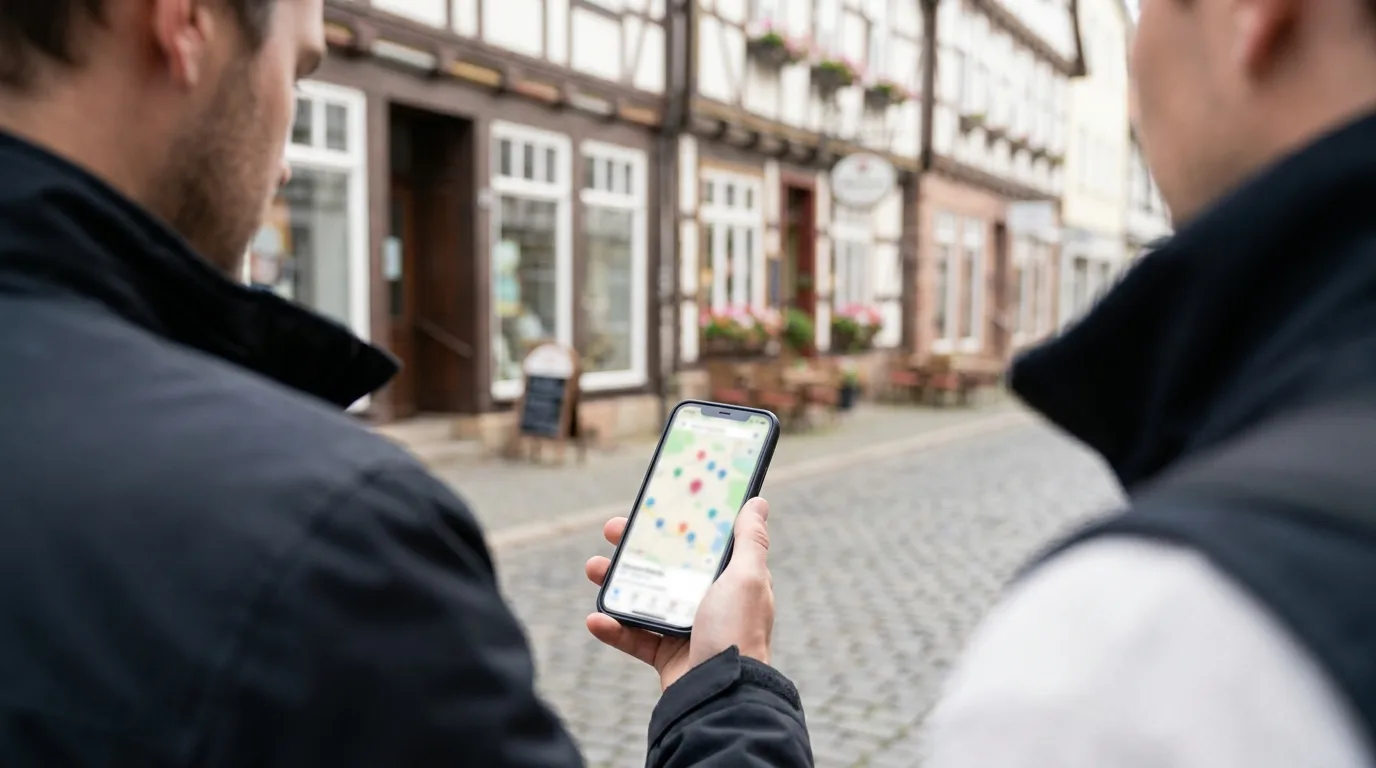
Open Google Maps or Apple Maps, search for a trade in your neighborhood — and check one thing on every result: is there a website link? No link, or a link that goes to a social profile instead of a real site, means: candidate. Note the name and phone number. Ten minutes gives you your first call list.
The underrated bonus of this method: these businesses at least made it onto the map — so they've understood, in principle, that visibility matters. That makes the conversation easier.
Method 2: The directory cross-reference (the thorough method)
Business directories — Yelp, Yellow Pages, your local chamber-of-commerce listings — include businesses that never even made it onto the map apps: the most invisible of the invisible. Flip through a category and spot-check: does Google find this business? Does it have its own site? A business that's listed in a directory but doesn't exist digitally is the most valuable lead there is: it verifiably exists (it registered itself), but loses every customer who searches online.
Method 3: The walk with open eyes
Old-fashioned and effective: walk the main commercial street in your neighborhood. Every shop, every workshop, every studio — a quick look at the storefront (name), a quick search on your phone. The advantage: later, on the call, you can honestly say "I'm just around the corner from you" — local proximity is a genuine trust argument with small businesses, one no big-city agency can compete with.
Method 4: The industry shortcut
Not all industries are equally fruitful. In our own research experience, the no-website rate is highest in the trades — painters, plumbing and heating, cleaning companies, roofers, masons — followed by small service businesses like nail and beauty studios. The logic: these businesses have always lived on word of mouth and never had "time for that stuff". Photographers, agencies and consultants, on the other hand, almost always have a site — there, the redesign angle beats the new-client search.
💡 Don't forget the redesign lane: A business WITH a website is not a lost lead. If the site looks ancient, doesn't work on a phone, or has shown "News from 2021" for years, a fresh draft next to it is an extremely persuasive before-and-after.
Method 5: The referral snowball (from client #1 on)
The easiest lead is the one your first client brings you. Tradespeople know tradespeople: the painter knows the tile setter, the hairdresser knows the beautician next door. After handover, ask directly: "Do you know anyone else who doesn't have a site?" — and offer a small referral discount if you like. From three or four clients on, this route often brings more than any active searching.
First contact: three sentences on the phone
One thing first: skip the mass cold email. The legal rules for unsolicited commercial outreach differ by country — in the US, CAN-SPAM regulates commercial email and do-not-call registries exist for phone; in much of Europe, cold email to businesses is effectively prohibited. Check what applies where you operate. The practical guidance is the same everywhere: a short, relevant, friendly call to a business your offer clearly fits is the accepted way in — and it works because it's personal. The entire script:
- "Hi, this is [name], I'm a web designer here in [neighborhood]."
- "I noticed you're hard to find online — and I took the liberty of building a draft of what your website could look like. No strings attached."
- "Can I text or email you the link? If you like it, we'll talk — if not, you've lost two minutes and gained a compliment."
The draft built in advance is the key: you're not asking for trust, you're showing a result. The most common answer to this call isn't "no" — it's "alright, send it over."
⚠️ Stay fair: Call during business hours, accept a no the first time, and don't promise what you can't deliver ("#1 on Google" is something nobody can honestly guarantee). Your reputation in the neighborhood is your capital.
Bottom line
You won't find your first web clients in job postings — you'll find them on the map of your own neighborhood: the map-app check for the fast, the directory cross-reference for the thorough, the walk for the local, trades-first for the efficient — and from client number one, the referral snowball takes over. First contact is a friendly three-sentence call with a finished draft. That's all the system you need to start — what's left is the first call. (How to turn that lead into a paid project is covered here.)
FAQ
Which industries are least likely to have a website?
In our experience the trades lead (painters, plumbing/heating, cleaning, roofing), followed by small studios (beauty, nails, massage). Restaurants are mixed — many only have a social profile instead of their own site, which is also a good conversation opener.
Am I allowed to just call businesses?
In most places, a relevant business-to-business call is the accepted first touch — but telemarketing rules (like do-not-call registries) and email rules (like CAN-SPAM, or much stricter laws in Europe) differ by country, so check what applies where you operate. The safe universal rules: be relevant, be brief, accept a no.
Should I really build the draft BEFORE the first contact?
Yes — it's the single biggest difference in success rate. A link someone can look at turns a sales call into a gift. With modern tools the draft takes minutes, not evenings.
What if the business says "we don't need that"?
Say thanks, hang up, next. Some businesses genuinely run entirely on regulars — that's fine. Your list is longer than their no.
Methods 1, 2 and 4 at the push of a button: LumaSite's lead search finds businesses without a website in your area — with phone numbers and a one-click draft for the first call. 3 free credits to try it.
Try it free — 3 free credits →Keep reading

One honest guide per week
Free, straight to your inbox — finding clients, selling websites, starting clean. No spam, one click stops them anytime.
✓ Check your inbox — click the confirmation link and you’re in.